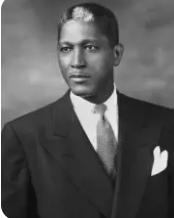
“Remembering His Story”

Belford Lawson was born and raised in Roanoke, Virginia. He was one of Belford and Sarah H. Lawson’s eleven children. Like many other African Americans wanting to further their education, he had to attend school elsewhere. In Michigan, he attended the Ferris Institute and the University of Michigan.
Although Attorney Belford Lawson was not a Living Legend of Alexandria, he was a legend in his own time who paved the way for young attorneys like Jay-Jay McCargo.. Attorney Belford Lawson was the first African American to win a case before the U.S. Supreme Court.
Additionally, Attorney Belford Lawson was a mentor to Edwin Haynes, a graduate of Howard University School of Law, who worked as a law clerk in Attorney Lawson’s law office in Washington, D.C.
Some of his contributions are outlined below.
After graduation, he taught social sciences and was a football coach at Jackson College in Jackson, Mississippi, and Morris Brown College in Atlanta, Georgia. He studied law at Yale University for two years and then moved to Washington, DC, where he graduated from the law school at Howard University in 1931. In 1933 he began his law practice in Washington, DC.
Lawson was married to Marjorie Alice McKenzie, also an accomplished attorney who challenged urban renewal and was the first Black judge in Washington, DC. His sister was Roanoke educator Sadie Lawson, and his brother was Fred Lawson, Roanoke teacher and football coach.
Belford Lawson was well known as a prominent civil rights attorney and activist.
- In 1933 he was one of the founders of the New Negro Alliance, a civil rights organization in Washginton, DC, that facilitated grassroots protests to showcase employment discrimination and economic disparities and injustices. The Alliance published a weekly newspaper, New Negro Opinion, that facilitated the organization’s activities (mass mailings, picketing, petitions, etc.) and engaged discussion among varied interests.
- In 1938 Lawson was the first African American to win a case before the U.S. Supreme Court. He was lead counsel for New Negro Alliance v. Sanitary Grocery Co. The White-owned grocery store in Washington, DC, with mostly Black customers, refused to employ African Americans as managers or sales clerks. Protesting the personnel policy, picketers with large placards marched in front of the grocery claiming racial discrimination.The grocery deemed that the protest unlawfully disrupted business and filed an injunction to stop the picketing, arguing that it was a labor dispute. Two lower courts upheld the injunction to stop the picketing. The Supreme Court reversed the decision and found that persons having an interest in the terms or conditions of employment should be at liberty to advertise and disseminate facts and information peacefully in order to persuade others about their employer’s practices.
- In 1950 Lawson won a lawsuit before the U.S. Supreme Court, Henderson v. United States, et al., that abolished segregation in railroad dining cars. The court determined that during interstate commerce it was unconstitutional, and an unreasonable and unjustified act of discrimination, to require segregation of Black passengers in a dining car occupied by Whites. Prior to the ruling, the Southern Railway had designated tables, White or Black, on its dining cars, separated by a curtain.The case had its beginnings from a dining car incident in 1942 (Henderson v. Southern Railway) followed by modified dining car rules in 1946 and court appeals.
- In 1956 Belford Lawson was the first Black man to address the Democratic National Convention. He was an early advisor to John F. Kennedy on civil rights and helped Kennedy gain support from African American leaders during the 1960 presidential election.
- Lawson was active in Alpha Phi Alpha, serving as national resident, the United Negro College Fund, the YMCA of Metropolitan Washington, and served on many boards of civic and business organizations.
“His heart was the heart of a warrior. Warriors love to fight and they fight to win.”
—Belford V. Lawson III, Esq., Feb. 2014
Personal Remarks for Groundbreaking Gainsboro History Walk
The True Meaning of Legacy & Legend
