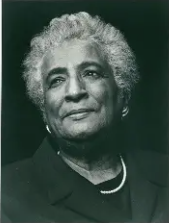
Lawyer.Advocate.Judge.ElectedOfficial.

One of LDF’s first female attorneys, Constance Baker Motley wrote the original complaint in Brown v. Board of Education and pioneered the legal campaigns for several seminal school desegregation cases. She was the first Black woman to argue before the Supreme Court and went on to win nine out of ten cases.
Motley became the first Black woman to serve in the New York State Senate and the first woman to serve as Manhattan Borough President. When President Johnson appointed her to the United States District Court for the Southern District of New York, she became the first Black woman to sit as a federal judge.

The Life and Legacy of Constance Baker Motley
Constance Baker Motley was born on September 14, 1921, in New Haven, Connecticut. She was the ninth of 12 children born to Rachel Huggins and McCullough Alva Baker, immigrants from the Caribbean island Nevis. Her mother was a community activist and founded the New Haven NAACP. Motley graduated from New York University in 1943 and attended Columbia Law School. She began her career at LDF in 1945 as a law clerk and was promoted to assistant special counsel in 1949. LDF’s second female (and first Black female) attorney, Motley rose to prominence Motley rose to prominence as the chief courtroom strategist of the civil rights movement. In addition to successfully litigating cases that ended segregation in Memphis restaurants and at whites-only lunch counters in Birmingham, Alabama, Motley defended Rev. Martin Luther King, Jr.’s right to march in Albany, Georgia.
DESEGREGATION ARCHITECT.


Motley was a key architect in the fight for desegregation in the South. From 1945 to 1964, Motley worked on all of the major school desegregation cases brought by LDF. She led the litigation of the case that integrated the University of Georgia and directed the legal campaign that resulted in the admission of James H. Meredith to the University of Mississippi in 1962, paving the way for the integration of universities across the south.
Motley claimed her greatest professional achievement was the reinstatement of 1,100 Black children in Birmingham who had been expelled for taking part in street demonstrations in the spring of 1963. Motley faced the danger of her work head-on — from driving through Ku Klux Klan territory to defend the right of Black students to attend the University of Georgia to spending hours in county jails across the deep South helping to secure the release of detained civil rights activists like Martin Luther King, Jr.

LDF honored the legacy of Constance Baker Motley in a September 14, 2021 event — the 100th anniversary of her birth. The commemoration included remarks by Vice President Kamala Harris, Assistant Attorney General Kristen Clarke, son Joel Motley, and a panel featuring Harvard University Dean Tomiko Brown-Nagin, historian and professor Martha S. Jones, JD, PhD, and Estée Lauder Vice Chairman Sara Moss.
This year, LDF launched its groundbreaking Marshall-Motley Scholars Program named after Constance Baker Motley and LDF founder Thurgood Marshall. The MMSP supports and develops the next wave of civil rights lawyers in the South, where the majority of Black Americans live. Over the next five years, LDF will invest in the establishment of a corps of 50 civil rights attorneys equipped and prepared to advocate on behalf of Black communities in the South seeking racial justice and equity.